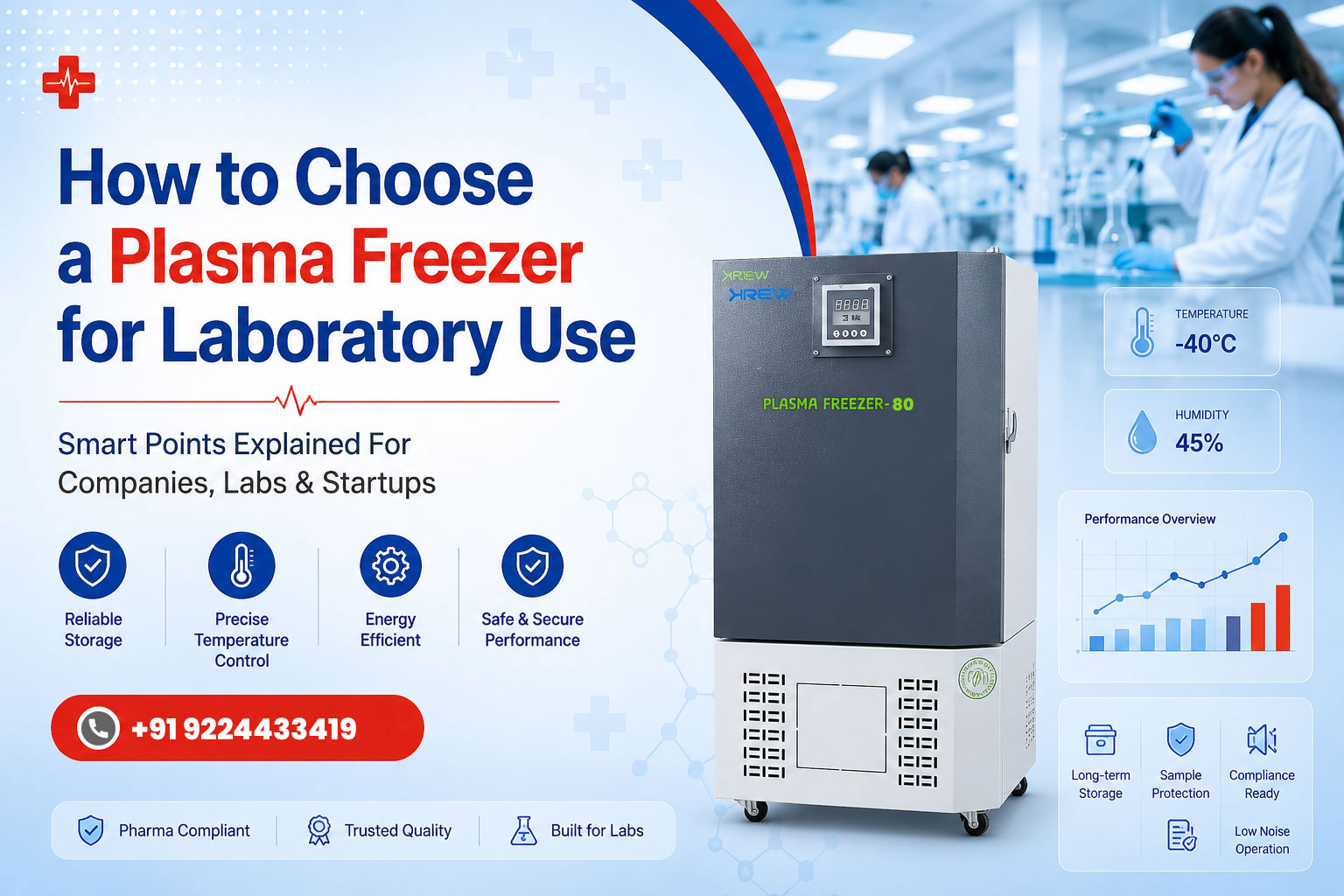
1. Plasma Storage Freezer Temperature Range & Stability
We need to get the temperature to thirty degrees below zero Celsius or even forty degrees below zero Celsius all over the place. The plasma will break down if it gets too warm inside the chamber even for a short time.
We should check that the temperature is the same not just in the middle. It should be the same on all the shelves with no than one degree Celsius difference. We should ask for a report that shows us how the temperature is over the place.
It is also important to get the temperature down. The faster we can freeze the plasma after we put it in the better it will be, for keeping the proteins safe. We want the plasma to freeze fast so the proteins do not get damaged.
2. Plasma Freezer Alarm & Monitoring System
Audible + visual alarms for temperature excursions are non-negotiable — a silent failure overnight can ruin months of samples.
Remote alarm connectivity (SMS, email, or LAN) lets you respond even when no one is physically in the lab.
Battery backup for the alarm system ensures alerts fire even during a power outage — not just the compressor backup.
3. Storage Capacity & Internal Layout
Calculate current volume + 30 – 40% growth buffer — buying undersized is the most common mistake new labs make.
Adjustable or removable shelves let you fit different plasma bag sizes (150 mL, 300 mL pouches) without wasted vertical space.
Check inner dimensions, not just "litre" rating — rated volume often counts unusable corners and frame space.
4. Power Backup & Compressor Reliability
Dual compressor models maintain temperature even if one compressor fails — critical for high-value sample collections.
UPS (uninterruptible power supply) compatibility should be verified — confirm the freezer's startup amperage won't trip the UPS.
Check hold-over time: how long does it stay cold during a total power loss? A minimum of 2–4 hours is expected.
5. Regulatory Compliance & Data Logging
For a blood bank or clinical labs you need to follow the rules set by the FDA 21 CFR Part 11 CE or the rules for storing blood in your area.
This is very important.
You see blood banks and clinical labs need to keep track of what they do so they use something called data logging.
This can be done with a USB, RS-232 or LAN connection.
It helps make a record of everything that happens which's necessary when people come to check on you like the ones from CAP or AABB.
These logs are special because they show when something was done and if someone tried to change things so you are protected if something goes wrong.
Just having a printout, from a spreadsheet is not enough to show the people who check on you you need these logs with timestamps.
Blood banks and clinical labs really need these -evident logs with timestamps to stay safe during investigations.
6. Defrost Mechanism
Manual defrost models are simpler and cheaper but demand staff discipline — frost build-up insulates the coils and tanks temperature control.
Auto-defrost cycles must be carefully engineered — a bad cycle can cause temperature spikes above –20°C, which is a sample integrity risk.
Check defrost cycle frequency and maximum temperature excursion allowed per cycle in the specs sheet before buying.
7. Serviceability & Spare Parts Availability
When you are buying a freezer it is an idea to pick a brand that has a service engineer in your area. This is because if your freezer breaks down you do not want to wait for three weeks for someone to come from another country to fix it. That is just too long to wait.
You should also find out if the company has parts available for things like the compressor and the door seals.. You should ask how long it will take to get these parts. You do not want to be stuck without a working freezer while you wait for a part to arrive.
It is also an idea to ask the company about how often they think you should have your freezer serviced.. You should ask how much this will cost. Sometimes the cost of servicing the freezer every year can be high. More, than ten percent of what you paid for the freezer in the first place. You should know about these freezer service costs before you decide which brand to buy.
8. Door Design & Access
A solid inner door or multiple inner compartments helps stabilize temperature when the outer door is open for sample retrieval.
Door gasket quality is often underrated — a compromised seal causes frost accumulation and steady temperature drift over months. For busy labs, a door-open alarm (separate from temperature alarm) prevents accidental long-term exposure that staff don't notice.9. Refrigerant Type & Energy Efficiency
I prefer to choose the HFC- natural refrigerant models when the rules allow it. The rules are changing fast. The value of old refrigerants is going down.
The HFC-free or natural refrigerant models are a choice because the rules are getting stricter. Energy consumption is a deal. It is measured in kWh per day. This directly affects how much it costs to run the HFC- natural refrigerant models.
If the HFC-free or natural refrigerant models are ten percent more efficient it makes a difference, over ten years.
When buying the HFC- natural refrigerant models I check for the Energy Star certification or something similar. Some companies need this certification when they buy things.
10. Vendor Reputation & Warranty
Ask peer labs what brand they use and whether they would buy again — lab forums and procurement networks are more honest than spec sheets.
A 3-year minimum warranty on compressor and control electronics indicates manufacturer confidence in build quality.
Demo units and trial installations are sometimes offered for large orders — always push for a temperature validation run before final acceptance.
11. Footprint & Installation Requirements
You need to measure the door clearance for the delivery route. If a freezer can not fit through the lab corridor that is a mistake.
The freezer has ventilation clearance requirements. These are usually five to fifteen centimeters on the sides and top. These requirements affect how you plan the bench and wall placement in the lab.
There are an options for the freezer configuration. Undercounter, upright or chest. The upright configuration is the common for plasma bags. The chest models are harder to organize. They lose less cold air when you open them. This is important, for the plasma bags and the freezer the plasma bags and the freezer.
12. Security & Access Control
A keyed lock is basic but essential if the freezer stores patient-identified or high-value research samples.
Some models offer user-access logging (PIN or RFID) — this is increasingly expected in GMP and ISO 15189-accredited labs.
Tamper-evident sealing options are worth asking about for forensic or chain-of-custody applications.
Contact Us
Looking for a reliable Plasma Freezer manufacturer?
Call or Whatsapp us today: +91 9224433419